
Why It is So Hard
When I asked my followers what they struggle with most in Russian pronunciation, the responses revealed something interesting: while normally most people are obsessed with the rolled R, you, my dear readers, know that the real problems often lie elsewhere. But more on that later.
Almost 100% of people effortlessly master the sounds of their mother tongue, yet only rare individuals can repeat that success later with a second language. Why is that so? Language courses usually provide very detailed grammar instructions for every aspect of the language, but dedicate only a few lessons to pronunciation training, as if language teachers doubt that adult learners can significantly improve their pronunciation. In the course on Teaching English as a Second Language that I once took, my instructors suggested never exceeding 10 minutes per lesson for pronunciation drills, because “they’re too tiring and frustrating for students.”
In the book Understanding Second Language Acquisition by Lourdes Ortega, the example of a British lady acquiring Egyptian Arabic pronunciation as late as in her 20s was an illustration for rare exceptions that happen under specific conditions (she married an Arabic speaker and moved to Egypt). Counter examples of immigrants not being able to get rid of their accents decades after moving to a new country are numerous (yours truly included). What’s wrong with us? Why can’t we master the pronunciation of any language other than our native one? And, most importantly, what should we do about that?
Learning vs Acquisition
Human language is a very interesting thing. We are used to thinking about languages as school subjects, something that can and should be understood and learned. But we never learned the language we speak best — our mother tongue. Of course, we once learned how to read and write, but even back then, in our pre-school years, we were very fluent speakers.
The reason why we speak our native languages so well is exactly because we didn’t learn them. We acquired them. Probably, we get accustomed to the sounds of native speech even before we’re born. Babies begin distinguishing voices very early in their lives, along with emotions. Then words. At some point we begin separating sounds of speech from non-speech sounds, and this is when our minds get the idea of what our language is. We memorize those sounds as “speech,” and then spend a few months training our articulation apparatus, babbling and cooing. Finally, we say our first words. Usually, a few more years are needed to perfect our articulation. By age 6 to 8, the majority of children master the sounds of their mother tongue well, with the exception of some specific sounds that take more precise coordination, but that usually don’t interfere with communication and can be fixed later, if needed.
During first language acquisition, we don’t rationalize our pronunciation, we don’t try to understand it. We hear, and we try to repeat. This is just one of the tasks that we learn to do when we’re growing: walking, using the potty, using a spoon, speaking. This is physical, and this is different from, say, understanding the concept of quantity (“Where are Fluffy’s eyes? Here they are! How many eyes does Fluffy have, huh?”). This part of the language is pre-rational, though even then we use a lot of self-monitoring and collect feedback from adults. We develop articulation skills in the way we develop fine motor skills — through active acquisition. Linguists use the term “articulation habits” for those muscle movements that we acquire during our babyhood and that constitute our accent.
And then, much later in life, we take language classes.
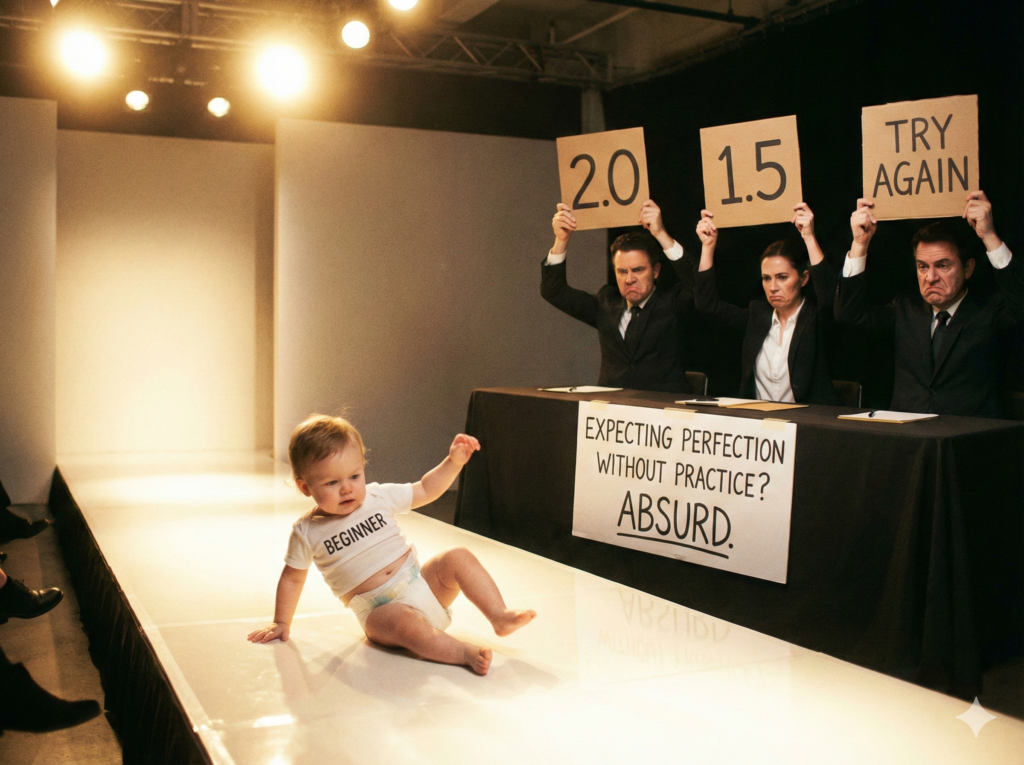
The chances to repeat the steps we took for mastering our native language in a classroom environment are practically non-existent. We can’t have enough exposure, we don’t have native speakers around 24/7 who would readily correct our pronunciation in a friendly and loving manner. And in school, we learned to avoid mistakes. We believe that mistakes are bad, and we don’t let ourselves make enough mistakes. Yet mistakes are essential – if we were afraid of falling when we were babies, we wouldn’t have learned how to walk. Instead of letting us stumble and babble, language classes expect you to walk like a supermodel on a podium right after your ‘language birth.’
Language classes give you some idea how to pronounce words, and you try your best, but phonetic transcription is a mere suggestion, a rough approximation. Today, we can check Forvo, Google Translate, YouTube, TikTok and many other similar services, and it helps a lot, but still we retain our once-developed articulation habits and speak with a noticeable accent. Most likely you hear that your pronunciation is different, but you don’t babble as you did when you were a child (that’s way too weird for an adult to babble, right?). Nobody directs you, and you feel like you’re trying to find a path in the darkness. If you are brave, you just take a deep breath and say it, hoping for the best.
It’s not your fault that the outcome is less than perfect. There is nothing wrong with you or with your language skills. You’re not stupid — acquiring pronunciation has nothing to do with IQ, and in fact, smarter people are often worse at mastering pronunciation of their target languages (their ego hurts more when they make mistakes). It’s just that you never went through the “physical” phase of language acquisition, you didn’t play with your tongue, and you didn’t have volunteering adults to teach you what’s right, both by modeling and providing feedback.
So, does that mean that you have to stop speaking any new language? Not at all. Having an accent in a non-native language is totally fine, as long as it doesn’t interfere with understanding. But if you want to improve your Russian pronunciation — and based on your poll responses, you definitely do — there are ways to work with your adult brain and body to get closer to those elusive Russian sounds.
In the next part, we’ll dive into specific Russian sounds that give learners the most trouble, why they’re so challenging, and practical techniques to master them — even as an adult. We’ll tackle the sneaky problems that actually affect your comprehensibility most.